This article explains how to add application policies in Refari, so every candidate agrees to your policies before they apply for a job or register with you. The same policies cover both, so you set them up once. It covers adding, changing and deleting a policy, and shows exactly what candidates see when they apply and when they register.
What an application policy is
An application policy is a document a candidate must agree to before their details reach you, for example your Privacy Policy, a Privacy Collection Statement, or your terms for candidates. Rules on what candidates must be told differ between countries and industries, so Refari lets you list your own policies rather than fixing one set for everyone.
Each policy is simply a name (what the candidate reads) and a URL (the web page or document the name opens). The policy itself stays on your website; Refari asks the candidate to read and agree to it.
Note: Despite the name, application policies are not only for job applications. Every policy you add also appears on your registration form, so candidates who register with you agree to exactly the same policies as candidates who apply for a job.Where candidates see your policies
Your policies appear every time a candidate sends you their details through Refari:
- Job applications: when a candidate clicks Apply Now on a job on your job board.
- Applying with LinkedIn: when a candidate applies for a job using their LinkedIn profile.
- Registrations: when a candidate fills in your registration form (the Register with us form on your website) and clicks Submit. A registration is a candidate signing up with you without applying for a particular job, so you can match them to roles later.
In every case the candidate must tick each policy before their application or registration is sent.
Adding an application policy
Application policies are set by a Company Admin. A Company Manager can see them but cannot change them.
- Go to Settings > Company Settings.
- Scroll down to the Application policies section.
- Click Add policy. A new row appears with a Name box and a URL box.
- Type the policy's Name exactly as you want candidates to see it, for example Privacy Collection Statement.
- Type or paste the full URL of the policy, starting with https://.
- Click or tab out of the URL box. The policy saves by itself, a green tick shows beside each box, and the policy appears straight away on both your job applications and your registration form.
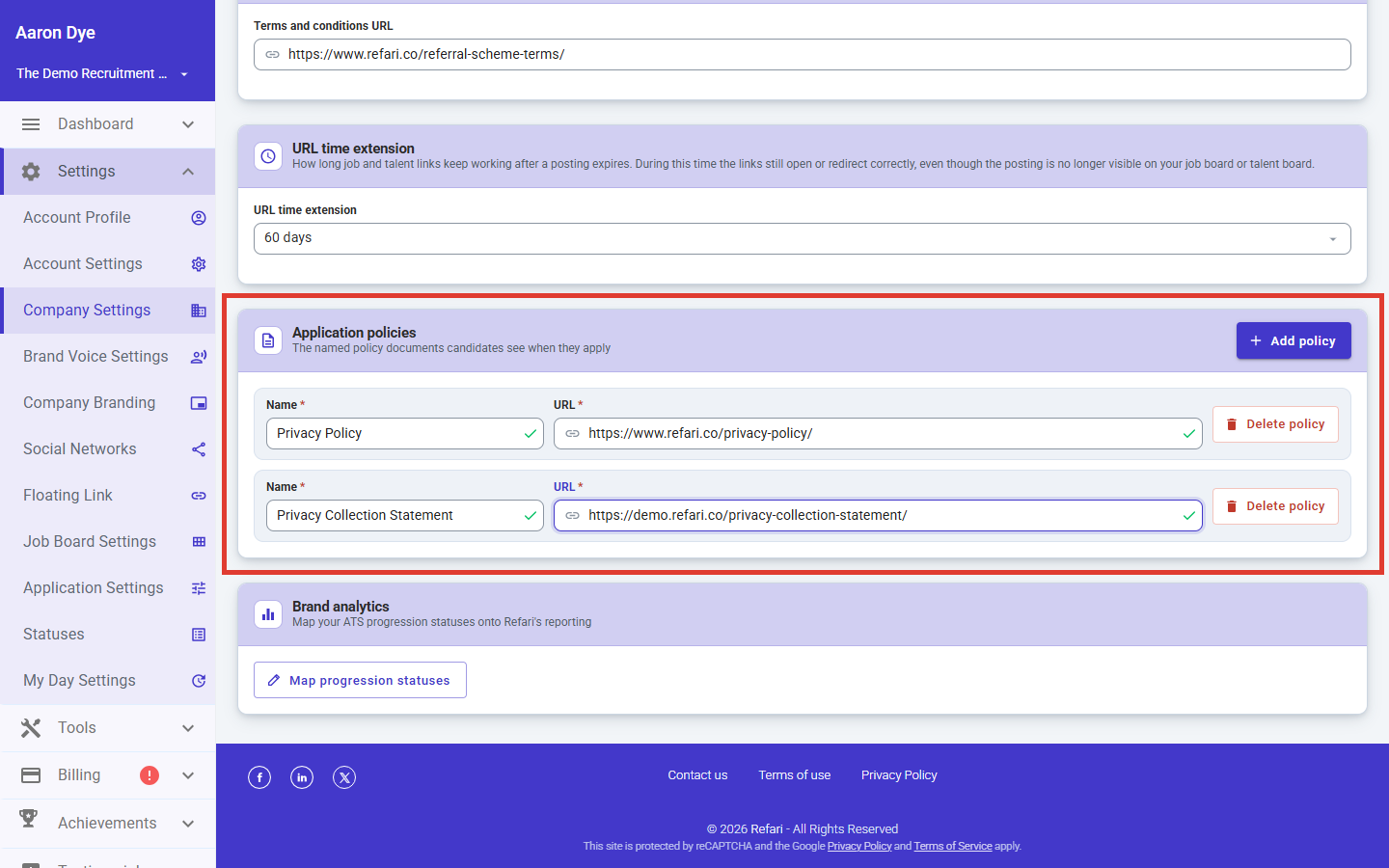
Note: There is no Save button for this section. A policy saves when you leave the URL box, and only once both the Name and the URL are filled in. You can add up to five policies; the Add policy button disappears once you reach five.Changing or deleting a policy
To change a policy, edit its Name or URL in place. The change saves when you leave the box, just as it does when you add one, and candidates applying or registering see the new version straight away.
To remove a policy, click Delete policy on its row. Refari asks you to confirm, naming the policy you are about to delete. Click Delete policy again to remove it, or Cancel to keep it.
Warning: Deleting a policy cannot be undone. It disappears from your job applications and your registration form straight away, so if you are replacing a policy, add the new one before you delete the old one.What candidates see when they apply for a job
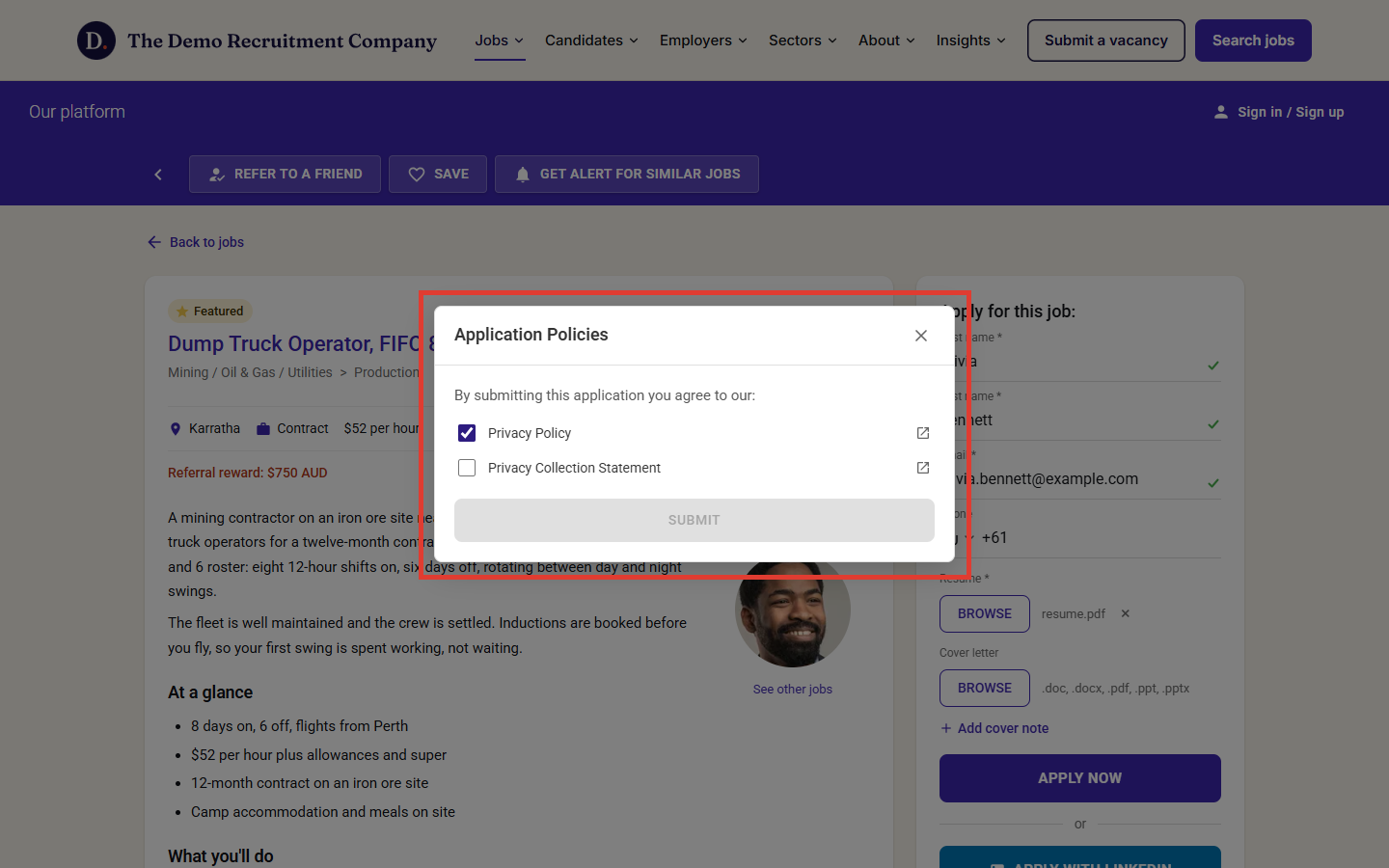
When a candidate has filled in their details and clicks Apply Now on your job board (or applies with LinkedIn), a pop-up appears before anything is sent.
- The pop-up is titled Application Policies and says By submitting this application you agree to our:
- Each policy is listed by name with a tick box. The small icon beside each name opens that policy in a new tab, so the candidate can read it before agreeing.
- The Submit button stays greyed out until the candidate has ticked every box. Their application is only sent once they submit.
- If the candidate closes the pop-up after ticking some boxes, Refari asks whether they are sure, because their application will be cancelled if they don't agree.
What candidates see when they register
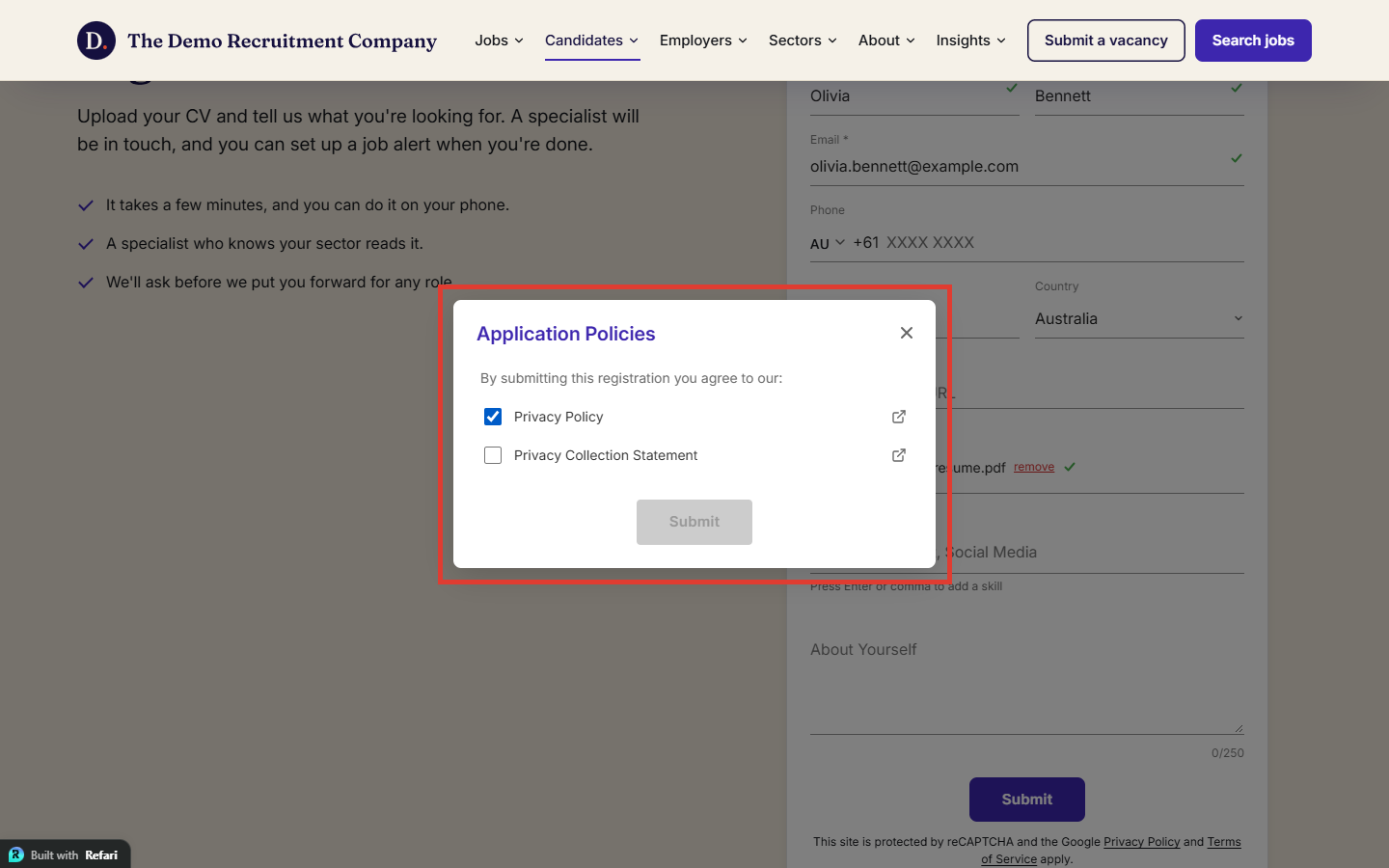
Registrations work the same way. When a candidate fills in your registration form and clicks Submit, the same pop-up appears with the same policies before their registration is sent.
- The pop-up is titled Application Policies and says By submitting this registration you agree to our:
- Each policy has its own tick box, and the icon beside each name opens the policy in a new tab.
- The Submit button in the pop-up stays greyed out until every box is ticked. The registration is only sent once the candidate submits.
- If the candidate closes the pop-up instead, nothing is sent and they stay on the registration form.
Idea: After adding a policy, test both places a candidate meets it: start an application on your job board, then fill in your registration form. In each pop-up, click the icon beside the new policy and check that it opens the right page for anyone, without a login.You're all set: when your policies show in the Application policies section with a green tick beside each Name and URL, every new job application and every new registration asks candidates to agree to them.Final Notes
Keep each policy on a public page that you control, so you can update the wording without changing anything in Refari, and remember that one list covers both applications and registrations. If you need a starting point for the policy itself, our example privacy policy for recruitment websites ↗ is a useful template to adapt with your own advisers.
Other articles you might be interested in: Managing candidate consent, privacy and marketing preferences in Refari | Candidate Registration Widget: how to install it and the customisation available | Every setting on the Company Settings tab explained
Was this article helpful?
That’s Great!
Thank you for your feedback
Sorry! We couldn't be helpful
Thank you for your feedback
Feedback sent
We appreciate your effort and will try to fix the article